Fill-in Word: Crossword Puzzle
- 4.9
- Rating
- 10.00K
- Installs
- Free
- Price
 Analysis by App-foxy
I usually know within a week whether a word game deserves a permanent place on my phone or whether it was only attractive because it was new. Fill-in Word: Crossword Puzzle made a good first impression because it keeps the central idea easy to understand: complete a crossword-style grid by finding the words that fit. There is no complicated setup to learn, and the short store description, “Fill-in Word,” accurately points to the main activity without dressing it up as something it is not.
This is a free word game from CASUAL AZUR GAMES, aimed at players who enjoy vocabulary, spelling, and light logic challenges. I see it as the sort of title I would open while waiting for an appointment, taking a break from work, or winding down before bed. It does not need the commitment of a long strategy game, yet it gives me more to think about than a purely reflex-based distraction.
The important question, though, is not whether the first few sessions are pleasant. Most puzzle games can manage that. The better test is whether the solving routine remains satisfying after the novelty fades, whether the progression continues to make me think, and whether interruptions such as purchases or repeated puzzle patterns begin to wear me down. That is where this game becomes more interesting to judge.
You May Also Like

 Blood Strike: 2.5 Anniversary
Blood Strike’s Loadouts Turn Every Drop Into a Tactical Gamble
A close look at Blood Strike’s custom loadouts: how fast access to signature weapons reshapes its battle royale rhythm, rewards preparation, and narrows the gap between fights.

 Pandora - Music & Podcasts
Pandora’s Music Is Easy to Start, but Harder to Recover
Pandora’s strength is its low-effort path from a seed to a station. Its weak spot is how much confidence it asks you to place in connection, setup, and quiet recovery.

 8 Ball Pool
 Is Built on Rivalries, Rematches, and Routine
A close look at the rivalries, rematches, shared routines, and unanswered safety questions that turn a quick pool match into a persistent mobile community.

 Samsung Music
’s Quiet Strength Is Playing What You Already Own
Its reach comes less from spectacle than from dependable access to a personal library. That simplicity is both the app’s strongest retention engine and its ceiling.

 AccuWeather: Weather Radar
AccuWeather Review: A Quick, Clear Forecast for Everyday Decisions
For everyday plans, the best forecast is the one you can understand quickly. AccuWeather makes rain timing, radar, and local conditions easy to act on, with a few trade-offs.

 Hill Climb Racing
Why Hill Climb Racing Still Turns Crashes Into One More Run
A tiny car, a bumpy hill and one more upgrade: Hill Climb Racing keeps resurfacing because its simple chaos makes every near-miss feel personal.
More From Our News Desk



Why the first week feels inviting
I like how a first week with this game can become a low-pressure trial rather than a commitment: a few short sessions are enough to learn whether filling connected word spaces suits your habits. I’d use that time to notice which puzzles make me curious and which feel like work, then let that distinction guide how often I return. That early pattern matters more than trying to play every day.
A simple premise with room for thought
The appeal comes from the balance between recognition and deduction. I am not merely searching for random words; I am trying to understand how a word belongs in a particular place, how its letters support crossing answers, and how one uncertain entry can affect the rest of the grid. That makes each move feel connected to the whole puzzle.
For a new player, the low barrier matters. Someone who already enjoys crosswords can begin naturally, while a casual player can approach it without first learning a large set of rules. The game’s word-focused format also makes it suitable for short sessions. I can stop after one puzzle or continue when I am in the mood, rather than needing to protect a long uninterrupted block of time.
During the first week, I would recommend resisting the urge to solve every difficult entry immediately. The most useful habit is to fill the answers I am confident about, then use the crossing letters to narrow down the uncertain ones. This is more rewarding than guessing repeatedly, and it turns the grid into a visible reasoning process instead of a sequence of lucky taps.
The satisfying rhythm of a small win
What kept me returning early on was the rhythm: scan the available clues or spaces, place an answer, notice a new letter, and revisit an answer that previously seemed impossible. That loop is familiar to fans of crossword puzzles, but the digital format makes it easy to pick up whenever I have a spare moment.
There is also a useful difference between knowing a word and proving that it belongs. I may recognize a possible answer, but the surrounding letters have to support it. That small distinction gives the game its logic element. It rewards careful observation, not just a large vocabulary.
My practical first-week tip is to treat mistakes as information. If a word creates awkward crossings, I do not keep forcing it simply because it was my first thought. Removing a doubtful answer can reveal the structure of the puzzle more clearly. This approach is especially helpful for players who tend to become frustrated when a grid does not open quickly.
Who is likely to enjoy the opening sessions?
This game is a strong fit for people who like word searches, crossword-style challenges, and quiet mental exercises. It can also suit someone who wants a casual alternative to scrolling through social feeds. The Teen content rating means parents should consider whether the game fits their household expectations, even though the basic activity is a word puzzle.
I would be less enthusiastic about recommending it to players who need fast action, rich storytelling, or a highly social experience. The pleasure here comes from solving, not from character development, competition, or dramatic events. If a player loses interest whenever a game asks for patience and repeated concentration, the simple format may feel too restrained after the first few sessions.
What remains after the novelty fades
Once the opening appeal settles, I judge the game less by how quickly I finish and more by whether I still enjoy checking one answer against another. I find it helps to stop at a natural point instead of chasing a streak of solves; that keeps the activity feeling like a choice. The next question is whether this modest routine continues to earn a place over time.
The value of a repeatable mental routine
After the initial curiosity passes, the game’s lasting value depends on whether I still enjoy the act of working through words. That sounds obvious, but it is an important distinction. A puzzle title does not need a large feature list to stay useful; it needs a reliable reason to return. Here, that reason is the combination of vocabulary recall and grid-based deduction.
I find the best recurring use case is a predictable daily pause. For example, I might play while having a morning drink, during a commute when I am not driving, or between two tasks that require a mental reset. The game works well in that role because a short puzzle can feel complete, while a more difficult one can be left for later without turning the session into a major commitment.
Another practical use is as a gentle transition between demanding activities. After concentrating on work, I do not always want another complex app. A word grid gives my attention something specific to hold without requiring the emotional investment of a competitive game. That makes it more sustainable for me than entertainment built entirely around constant stimulation.
How it compares with familiar word-game alternatives
Compared with a traditional crossword app, this game feels more approachable because the fill-in structure keeps the task focused. A traditional crossword may place more emphasis on clue interpretation, cultural knowledge, or broad general knowledge. Fill-in Word: Crossword Puzzle is better suited to players who prefer using visible word patterns and crossing letters to build confidence.
Compared with a word-search game, it asks for more reasoning. Word searches often reward scanning and visual recognition, while this format makes each answer matter to other answers in the grid. That interdependence gives me a stronger sense of progress, although it can also make a stubborn puzzle more demanding than a quick word hunt.
Compared with an anagram game, the experience is less about producing as many combinations as possible and more about placing the right answer in the right context. Players who enjoy rapid rounds and constant score chasing may prefer an anagram alternative. Players who like a slower, more deliberate solve will probably get more from this one.
The trade-off is that the focused design may feel limited to anyone looking for several distinct modes in one package. I would choose it for a clean word-solving routine, not as an all-purpose replacement for every kind of vocabulary game.
Three habits that improve the longer experience
First, I separate recognition from certainty. When I see a word that might fit, I mentally mark it as a possibility rather than treating it as final. This prevents one early guess from controlling the entire grid and makes later corrections less irritating.
Second, I use crossing letters as a filter rather than waiting until I am completely stuck. Even one confirmed letter can change the likely shape of an answer. Working from the most constrained spaces often produces better progress than repeatedly staring at the same open area.
Third, I avoid turning every session into a test of endurance. If I have spent several minutes circling the same uncertainty, I take a break and return later. The benefit is not only less frustration; a fresh look often makes a familiar word easier to see. This is a small but meaningful way to preserve the game’s value as a habit instead of allowing it to become a chore.
Where maintenance and fatigue enter the picture
I think fatigue is easiest to manage when I treat a difficult grid as a reason to pause, not as a challenge I must beat immediately. A fresh return can make crossing letters easier to read, while a long spell of guessing can drain the pleasure from the puzzle. That distinction also helps me separate a temporary block from a genuine loss of interest.
The burden is mostly mental, not operational
For me, the maintenance burden is low in the ordinary sense. The game is free to start, runs on devices using Android 7.0 or later, and the current version is 6.2.3. I do not need to build a collection, manage a complicated strategy, or learn a rotating set of systems before I can enjoy a session.
The real maintenance question is whether I can keep my interest alive. Word games depend on variety, personal vocabulary, and a feeling that each puzzle deserves attention. If the solving patterns begin to feel too familiar, the game can move from a refreshing break to a routine obligation. That is not a technical flaw, but it is the central long-term risk of this type of title.
I also keep an eye on the optional spending model. The game is free, while in-app purchases range from $0.99 to $19.99 per item. That does not automatically make the experience poor, but it does mean I would approach purchase prompts carefully. I would first decide whether the basic loop is satisfying without spending, then consider whether any optional item genuinely improves my experience rather than simply helping me avoid a difficult moment.
My advice is to set a personal rule before playing: either keep the experience entirely free or decide in advance what kind of optional purchase, if any, feels reasonable. That prevents frustration during a stubborn puzzle from turning into an impulse decision.
What may cause the routine to become tiring?
The first source of fatigue is repetition. A crossword-style game can be relaxing when I want predictability, but that same predictability can become noticeable when I play too frequently. I get more lasting value by treating it as a small recurring activity than by trying to consume it for hours at a time.
The second is vocabulary mismatch. A puzzle can feel unfair when an answer is unfamiliar, overly specific, or simply outside my everyday language. That is a normal challenge for word games, but it affects motivation. I am more willing to struggle when the surrounding crossings offer a clear route forward; I am less patient when several answers remain equally plausible.
The third is the tension between hints and satisfaction. Assistance can help me move past a genuine block, but using it too quickly removes the reasoning that makes the game worthwhile. I prefer to spend a little time testing crossings first, then use help only when I have learned something from the failed attempts. That preserves the feeling that I solved the puzzle rather than merely completed it.
There is also a more personal limitation: this is not the best choice when I need a strong sense of progression outside the puzzle itself. Players who want extensive customization, a narrative campaign, or a competitive ladder may find the recurring word-solving loop too narrow. In those cases, a larger puzzle collection or a more feature-heavy alternative would probably earn more regular play.
How the audience response shapes my confidence
The game currently holds a 4.9 average from around 65 ratings, with 6 written reviews and over 10K installs. Those figures suggest a small but very positive audience response. I read that as encouraging rather than conclusive: the people who have rated it appear happy, but a compact audience cannot tell me as much about long-term variety as a much broader player base would.
That distinction matters for anyone choosing an app to keep for months. A high average can confirm that the basic experience works for its intended audience, but it cannot replace my own test of whether the puzzles continue to feel fresh. I would treat the positive reception as a reason to try it, not as proof that every player will find endless replay value.
My long-term verdict
My long-term verdict comes down to a simple fit: this is worth keeping if I want quiet, focused word solving, but not if I expect a steady stream of different kinds of play. I’d give it a fair try in short sessions and pay attention to whether the reasoning still feels satisfying without turning optional spending into a shortcut. That is the clearest way I know to decide whether it remains a useful break.
A good keeper for the right kind of break
After looking beyond the first-week appeal, I think Fill-in Word: Crossword Puzzle earns lasting space for players who genuinely like word deduction and want a calm, repeatable activity. Its strength is not spectacle. It is the clean satisfaction of placing an answer, watching the crossings confirm it, and gradually turning an incomplete grid into a finished one.
I especially recommend it to someone who wants a low-commitment puzzle for everyday pauses. It can fit into a morning routine, a quiet evening, or a short waiting period without demanding that I reorganize my day around it. That flexibility is more valuable to me than a large collection of distracting extras.
I would skip it if I were looking for action, deep narrative, multiplayer competition, or a broad collection of unrelated modes. I would also be cautious if repeated word patterns quickly bore me or if I dislike the possibility of optional purchases appearing in a free game. In those situations, a traditional crossword app, a word-search title, or a more varied puzzle package may be a better match.
My final recommendation is to approach it as a habit-sized game rather than a marathon. Play when you want focused relaxation, use crossing letters intelligently, and take breaks before the solving process becomes mechanical. Its strongest quality is the way it turns a few spare minutes into a small exercise in vocabulary and logic. That is enough for me to keep it installed, provided I continue using it as a refreshing routine instead of demanding unlimited novelty from a deliberately simple format.
FAQs for Fill-in Word: Crossword Puzzle
01What is Fill-in Word: Crossword Puzzle?
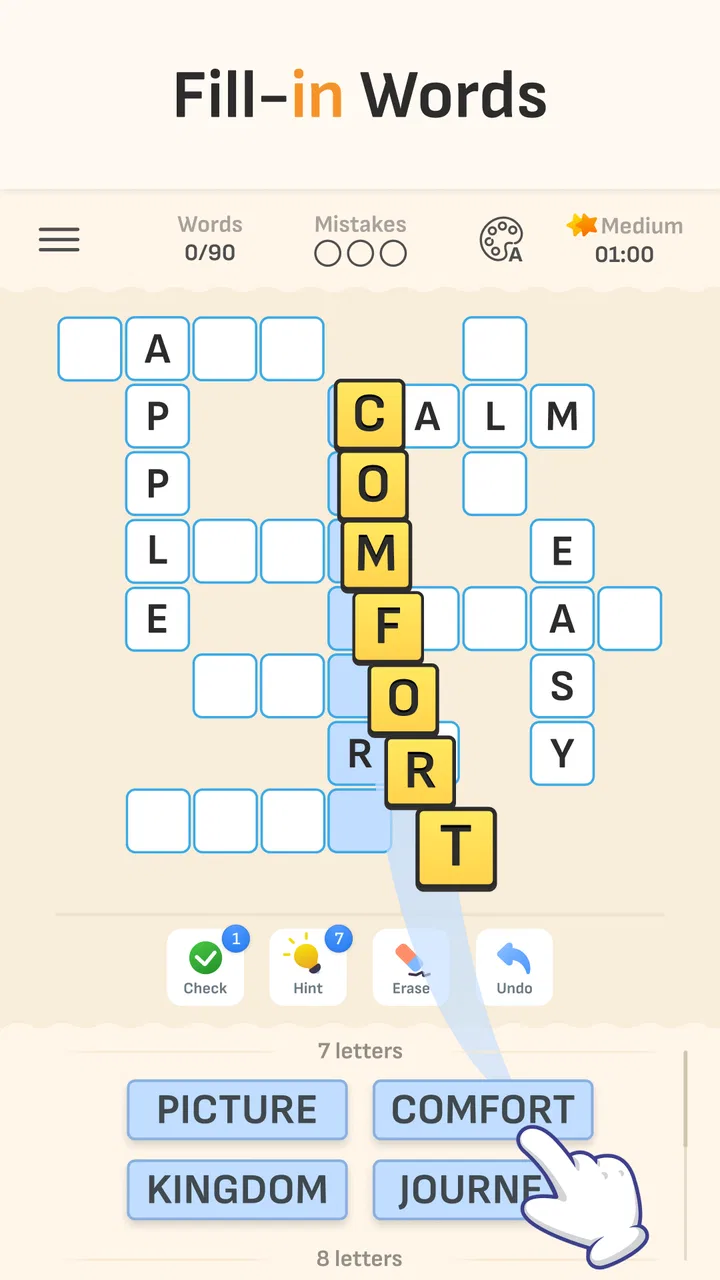
Fill-in Word: Crossword Puzzle is a word game that combines the structure of a crossword with a fill-in puzzle format. Instead of solving every clue from scratch, you place the provided words into the correct spaces on the board. The game is easy to understand, but later puzzles can become surprisingly challenging as several words may share similar lengths and intersecting letters.
02How do you play Fill-in Word: Crossword Puzzle?
Each level presents a puzzle grid together with a collection of words that must be placed in their matching positions. You can usually tap or drag a word into an available row or column, using crossing letters and word lengths as clues. If you get stuck, the game may offer hints or assistance, although using these features can reduce the challenge for players who prefer solving everything independently.
03Is Fill-in Word: Crossword Puzzle suitable for beginners?
Yes, the game is generally approachable for beginners because it does not require advanced crossword-solving knowledge. Early levels introduce the basic mechanics gradually, allowing you to learn how word placement and intersecting letters work. However, the difficulty increases over time, so later boards may require patience, careful comparison of possible words, and occasionally the use of a hint.
04Can Fill-in Word: Crossword Puzzle be played offline?
Many puzzle levels may be playable without a constant internet connection once the necessary game content has loaded, which makes the app convenient for travel or short offline sessions. However, certain features can still require internet access, including advertisements, updates, cloud synchronization, leaderboards, or in-app purchases. Availability may vary by device version, so checking the app-store description is recommended.
05Does Fill-in Word: Crossword Puzzle contain ads or in-app purchases?
Like many free-to-download word puzzle games, Fill-in Word: Crossword Puzzle may include advertising and optional in-app purchases. Ads can sometimes appear between levels or when you request extra hints, while purchases may be offered to remove advertisements or obtain additional assistance. The core gameplay can often be enjoyed without spending money, but users should review the store listing and purchase settings before downloading.
Pros
- Relaxing gameplay suitable for short or extended sessions.
- Helpful hints make difficult puzzles more approachable.
- Clean interface keeps the focus on solving clues.
- Progress tracking encourages players to complete more puzzles.
- Good choice for improving vocabulary and spelling skills.
Cons
- Some puzzles may feel repetitive after extended play.
- Hints can reduce the challenge for experienced crossword fans.
- A stable internet connection may be needed for certain features.
- Small text can be difficult to read on compact phone screens.
- Ads may interrupt the experience between puzzles.

Fill-in Word: Crossword Puzzle
Gallery